When autumn arrives, Dennis Berhorst runs away from “trout water.”
During late summer and early fall, Berhorst starts running up the shallow riverine sections of a reservoir rather than fishing the impoundment’s clear lower part, which he calls “trout water.” The Missouri tournament competitor prefers the upper ends of reservoirs then because the water there has more color and is shallower, so it tends to cool down quickly. In contrast, the water on the lower end is usually gin clear and remains warm longer.
While most bass on the lower lake stay deep in early fall, bass in the upper shallow reaches become more active, triggered by baitfish movement, shortened daylight hours, and cooler nights. “The deeper bass (in the upper sections) start to get up on the bank, especially when the big gizzard shad get up shallow,” Berhorst says.
Even when the water temperature stays in the 80-degree range in the fall, Berhorst heads for the tributaries of a reservoir because most of the bass are always shallow. “There are deep fish up there, but because of the water color, you just don’t fish for those bass,” Berhorst says. The dirty water in the tributaries makes shallow bass less spooky than their lower lake cousins residing in the clear water.
Berhorst concentrates on the main channel of the upper reservoir in early fall and then keys on the pockets and coves as fall progresses. The 10-time Bass Fishing League (BFL) and Major League Fishing (MLF) Toyota Series winner catches upper reservoir bass 5 feet deep or less. “It’s mainly power fishing, shallow-water fishing whether it is wood or docks or whatever,” Berhorst says. “It is typically better in the afternoons than in the mornings. The sun gets up high and positions the bass to where you can catch them.” The sunshine pushes bass to the shady spots along docks, laydown logs, or in brush piles where the fish hold tight to the cover.
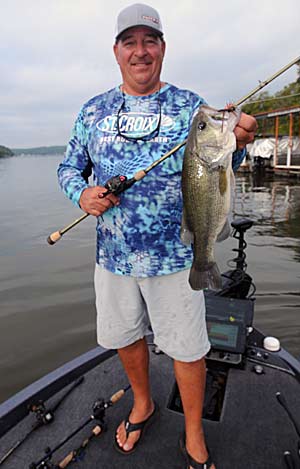
Weather dictates the types of lures Berhorst throws to upper reservoir bass. “A jig and a worm are both real good,” he says. Some of his other favorite lures for tributary bass are a Chatterbait, squarebill crankbait, and topwater lures such as Whopper Ploppers and Zara Spooks.
Fast-moving lures produce best for Berhorst in cloudy weather or sunny, breezy days. His favorite action lures are a white 3/8- or 1/2-ounce Chatterbait, shad-colored or bright white Strike King KVD 1.5 or Dave’s Custom Baits 2.5 square bill crankbait and bone-colored Zara Spook or Whopper Plopper. The eight–time BFL All American qualifier throws the Whopper Plopper for aggressive bass and the Zara Spook for less active fish.
Continue reading at bassresource.com